Leaving the Mountain
The one-sentence version
For eighteen months a man rode his bike almost every single day through the mountains above Los Angeles — and then, in the span of about five months, he stopped being an LA cyclist, stopped riding, and moved 380 miles north, in that order. The collapse was an identity migration before it was a relocation. He didn't burn out on cycling; he reframed it — into photography — and migrated his life onto Instagram and out of the San Gabriel Mountains. The move to the Bay Area didn't cause the ending. It just finished it.
| Total | 733 rides · 13,301 miles · 935,563 ft climbed · 1,624 hours moving |
| Peak year (2024) | 428 rides · 8,727 miles — a near-daily habit |
| The cliff | First missed week in 79: w/e Dec 15 2024 (a 4-sigma drop) |
| Last LA ride | Jan 24 2025 → 90-day void → first Bay ride Apr 27 2025 |
| The aftermath | 15 rides in 14 Bay-Area months; 0 descriptions, 0 club joins, 0 kudos given |
| Still there | Logged in through the export date, June 6 2026 — lurking, 16 months after the last word |
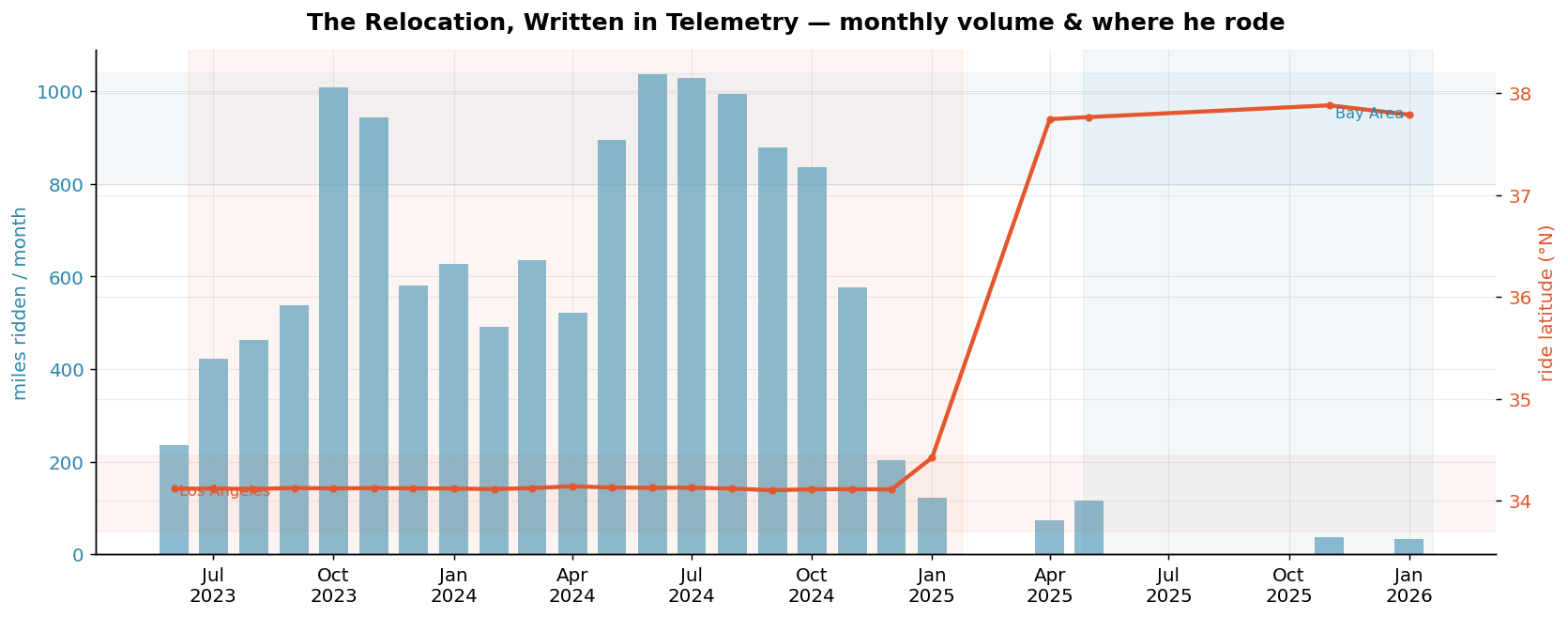
The blue bars are monthly mileage; the orange line is the latitude he rode at. For eighteen months the orange line is pinned to Los Angeles (34°N) while the bars tower. Then the bars fall to the floor and the line leaps to the Bay (37.8°N). The whole story is in that one divergence — the riding died at one moment, the geography moved at another, and they were not the same moment.
How to read this report
The analysis ran as an agent team: seven specialists (temporal, geospatial, physiological, environmental, social, gear, content) each mined one modality of the export, each was then independently adversarially verified by a red-team agent that re-derived every number and hunted confounds, and the survivors were synthesized into the story below. Numbers here are the verified ones; where the first pass was wrong, the corrected figure is used. The honest limits are in What the data cannot say, and every headline claim is tagged with a confidence level in the Claims ledger.
Act I — Infatuation (June–December 2023)
He appears in the data fully formed and already obsessed. On his very first day on Strava (June 11, 2023) he joined a club — "InCycle Pasadena Sunday Morning Riders" — and then 24 more LA/Pasadena/San-Gabriel-Valley clubs over the following months. Within weeks he was riding the way he would ride for the next year and a half: constantly.
The exploration is visible as a decaying novelty curve — 90% of his early rides entered brand-new territory, falling toward ~25% over the next year as the map filled in. That decay is the signature of a place becoming home. By autumn he was on a 45-day unbroken streak of riding every single day (Oct 4 – Nov 17 2023), and he would not miss a calendar week for 79 straight weeks.
This is also the only window in the entire record with real, measured physiology. For exactly 99 days (Nov 7 2023 – Feb 14 2024) a power meter was bolted to his Cervelo road bike, producing the only 32 rides out of 733 with true watts and cadence. It reveals a low-cadence masher (median 66 rpm, ~20 below the roadie norm) grinding out stochastic outdoor climbs — not a structured-intervals athlete. Then the meter went dark and never came back. The "serious training phase" was a three-month measurement experiment, not a regime.
A note on the watts you'll never trust: Strava shows an
avg_wattsfigure on 99% of rides, but it's estimated from speed and grade — and on the 32 metered rides the real meter reads ~35% higher (a fake +32 W step) at the exact same speed. Any "power trend" crossing November 2023 is an artifact. There is no heart-rate, no training-load, no perceived-effort data anywhere in the export. This report makes no claim about his fitness that rests on estimated power.
Act II — Belonging and the Mountain (2024)
2024 is the cathedral year: 428 rides, 8,727 miles, a calendar so full it's hard to find a blank day.
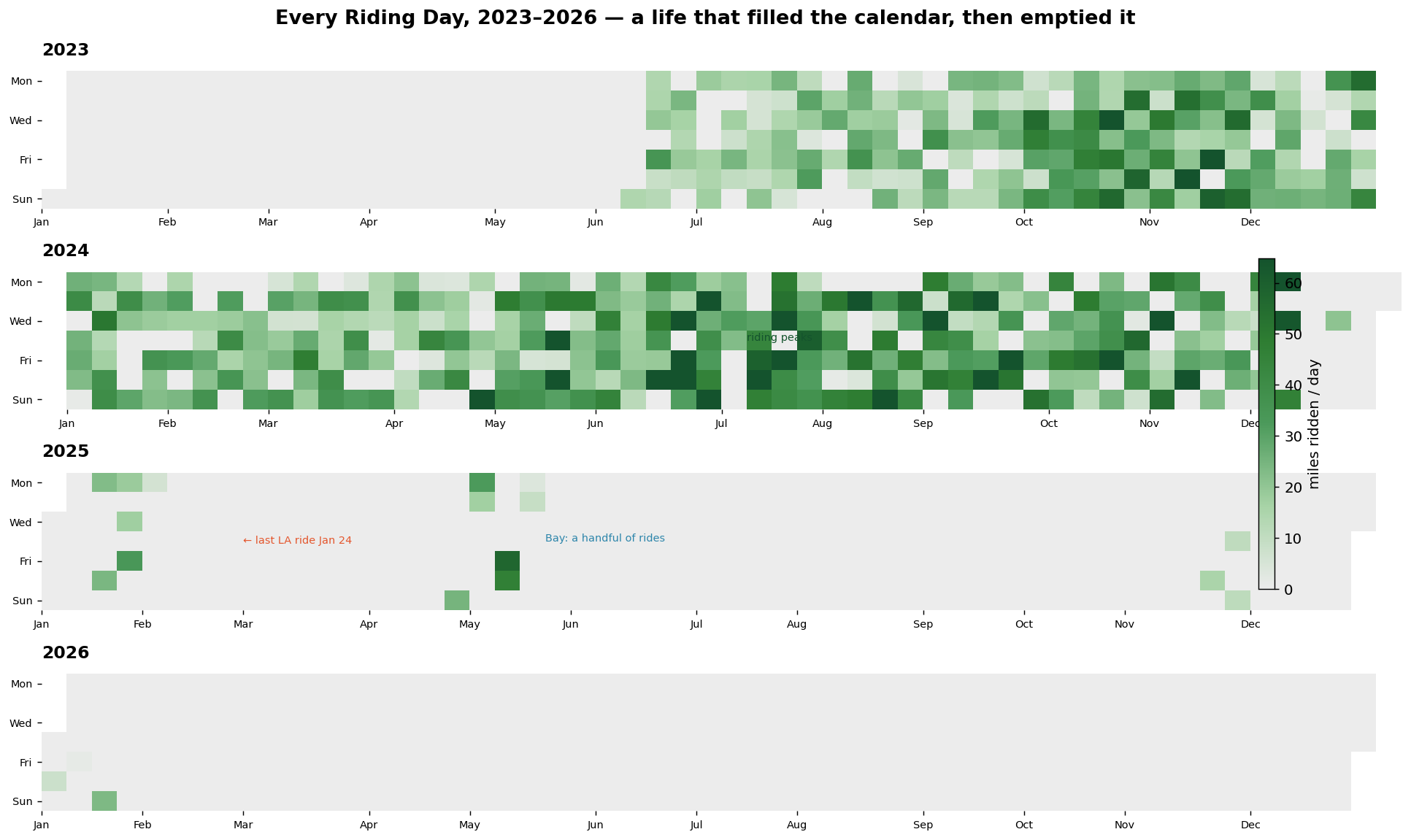
Look at 2024 — wall-to-wall green — and then 2025, almost entirely blank. That contrast is the entire thesis in one image.
Who he was, when the habit was alive, comes into focus only by stacking four modalities:
- Solo, nocturnal, weekday. ~46% of LA rides started at night (validated against actual local sunset times — a 00:06 ride against a 20:07 sunset is genuinely dark). Friday was his single biggest day; morning rides were ~3%. He was not a dawn-patrol group rider.
- The aspirational-club paradox. He joined 25 group-ride clubs — including that "Sunday Morning Riders" club on day one — yet logged only 3 Sunday-morning rides, ever. The clubs were identity scaffolding; the riding was almost entirely alone. (An ~8:1 gap between social intent and behavior.)
- Mountain-obsessed. All 44 of the >3,281-ft mega-climbs in the entire 2.5-year record are from this LA era. Zero are in the Bay. He summited Mt Wilson again and again ("Grinding Mt Wilson," "A Mt Wilson Christmas"). His biggest day climbed 6,834 ft ("LA invitational triple scoop," May 18 2024 — captioned "Ride of a lifetime").
- A fair-weather creature who raced the rain. 71.7% of rides started under clear skies, median 70°F. He rode through falling rain only 1% of the time — but 25 times he started a ride at >50% rain probability and beat the window ("Before the rains fell," at 86% probability, stayed dry). Wind, not cold, was his real gate: his single windiest ride is literally named "Wind kept me from continuing."
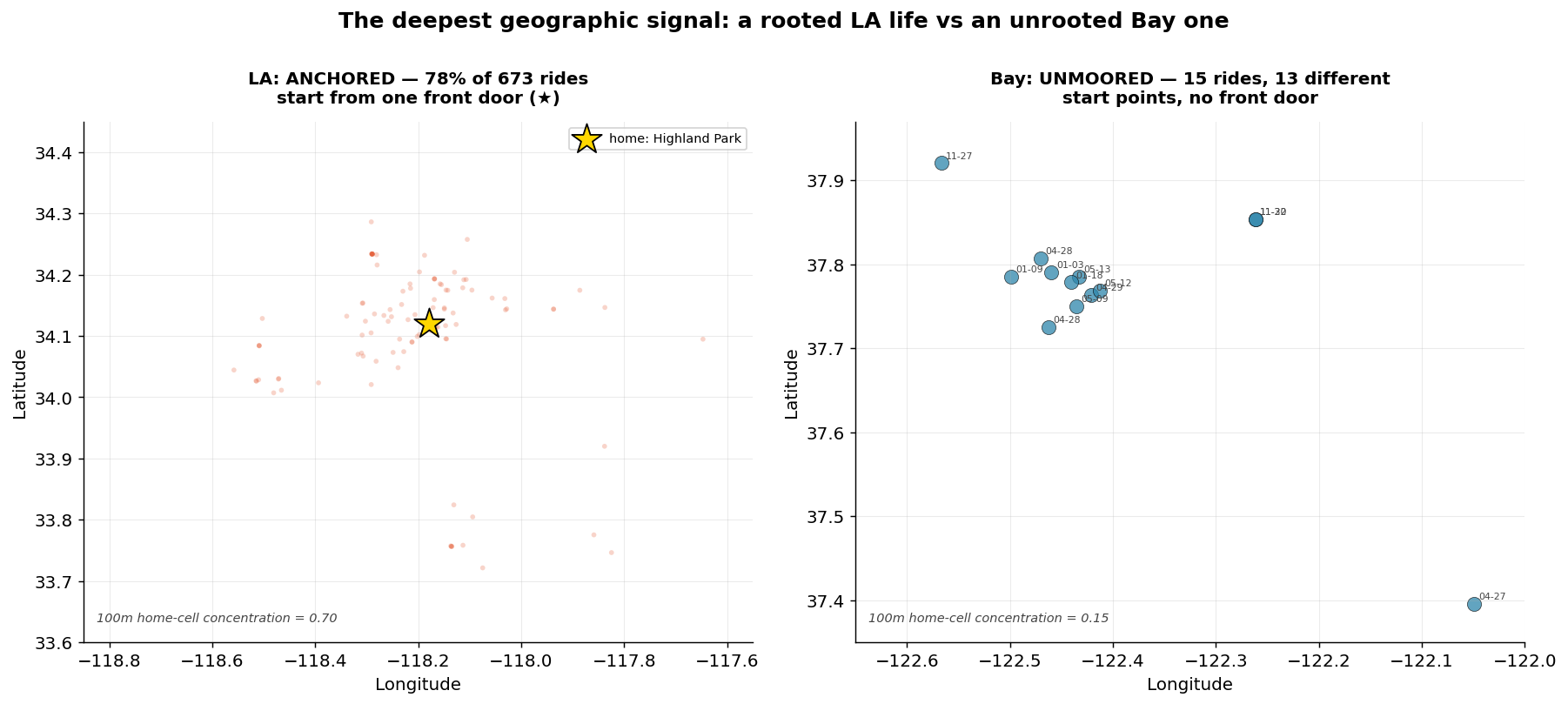
And he was anchored. About 82% of all 673 LA rides launched from a single 1-km cell in Highland Park — one front door. He almost never drove out to ride (median start: 0.18 mi from home); 94% of rides were loops that returned to within a few miles of where they began. This was not a man who shuttled to trailheads. This was a man whose neighborhood was the trailhead.
His own words from this period are saturated with belonging:
"South Pasadena is paradise." — May 30, 2024 "Los Angeles is really waking up these last few weeks and it's nice to feel that energy out there again." — May 13, 2024 "Welcoming myself home."
He was also becoming a leader. In the messages he's coordinating group rides (PAA, the Cub House GMR ride, the Bike Oven), naming friends — "cycling idol jeff," Morgan Tsai "photographer extraordinaire and route designer" — and stepping into authority:
"seems like I'm providing the routes locally for that ride now since I'm the most knowledgeable." — Sept 1, 2024 "increasingly feel a part of the biking community over here which really means a lot to me." — Oct 20, 2024
This is the peak. It is also, already, the beginning of the pivot — because the bike that would end his cycling career had just arrived.
Act III — The Pivot: a cyclist becomes a photographer (mid–late 2024)
On May 2, 2024, a new bike appears, and its first ride is named "Going slowly." Its name is "Slow Poke."
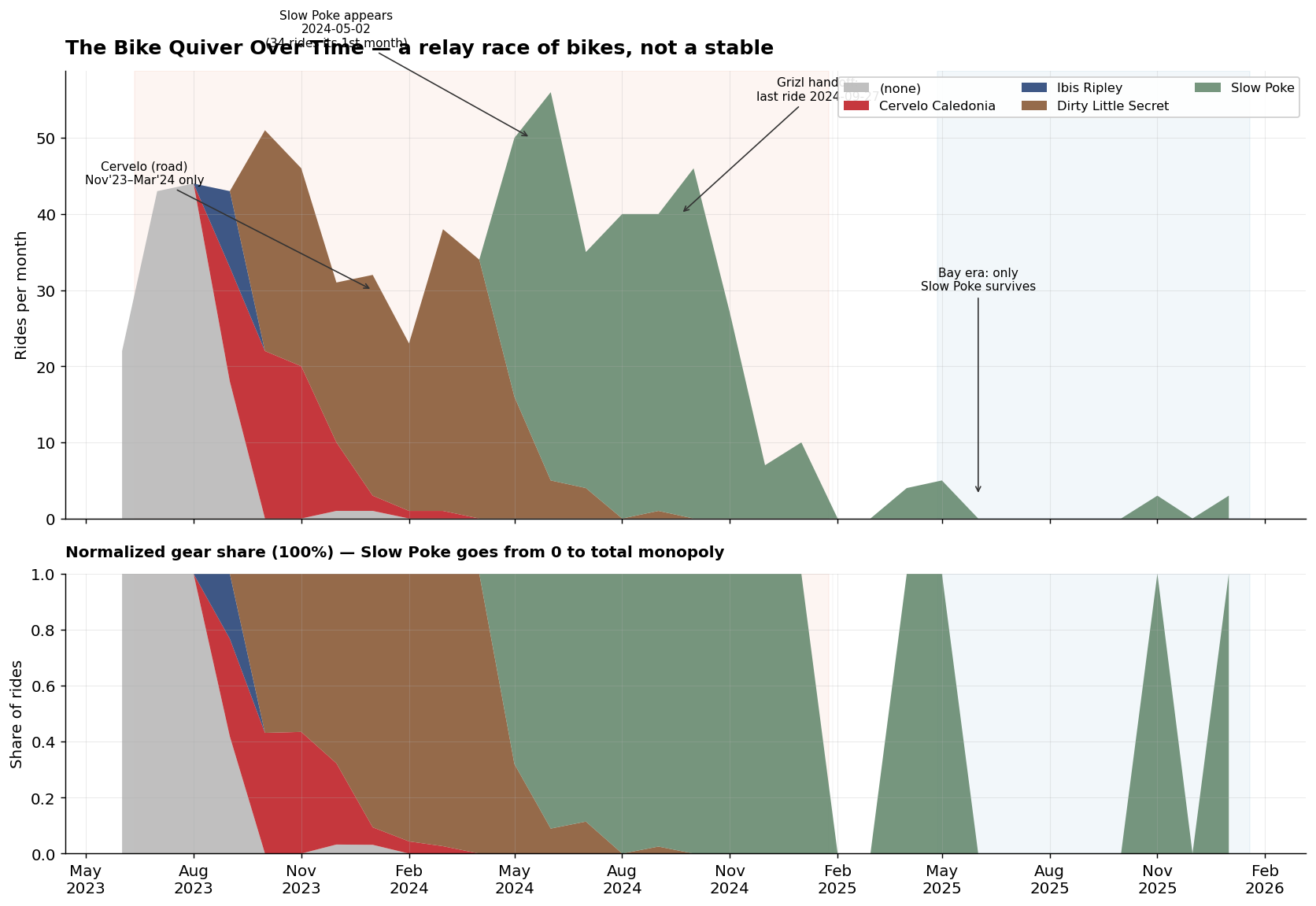
"Slow Poke" is the Rosetta Stone of the late era. Decoded across gear, physio, and content, it is a heavy (25 lb vs 20 for the others), paved, do-everything daily-driver — a townie, literally named for being slow (median 8.8 mph, the slowest of his road-capable bikes; the e-bike hypothesis is firmly rejected — e-bikes are fast, this is the opposite). Its ride names are errands and leisure: "Basket ride / holding on to the end of summer," "Farmers market Rockwood Old Town," "Classic cars and yogurt," "To Santa Monica, day at beach." It stops constantly (it spends half of each ride stationary). And the moment it arrives, it takes over — out-riding the gravel bike 34-to-16 in its debut month. The "quiver" was never a stable of co-owned bikes; it was a relay race (road → a 12-day MTB experiment → gravel workhorse → Slow Poke), each handing off to the next.
He narrates the shift himself, and it is unmistakably about life, not sport:
"With my newfound cargo capacity the lines between a bike ride and the rest of life are beginning to blur." — May 8, 2024 "Today began a new even slower phase of my cycling career." — May 2, 2024
Then the camera takes over. Photography mentions in his descriptions surge from ~8% (Q2 2024) to ~52% (Q3 2024), overtaking even bike mechanics. The bike becomes a tripod platform:
"Reinvigorating my photography… took the tripod to take some long exposure night photos from Mount Lowe rd." — June 27, 2024 "I couldn't stop taking photos. Nearly 300 shots." — July 16, 2024 "more of a photography trip than bike ride tbh." — Sept 17, 2024
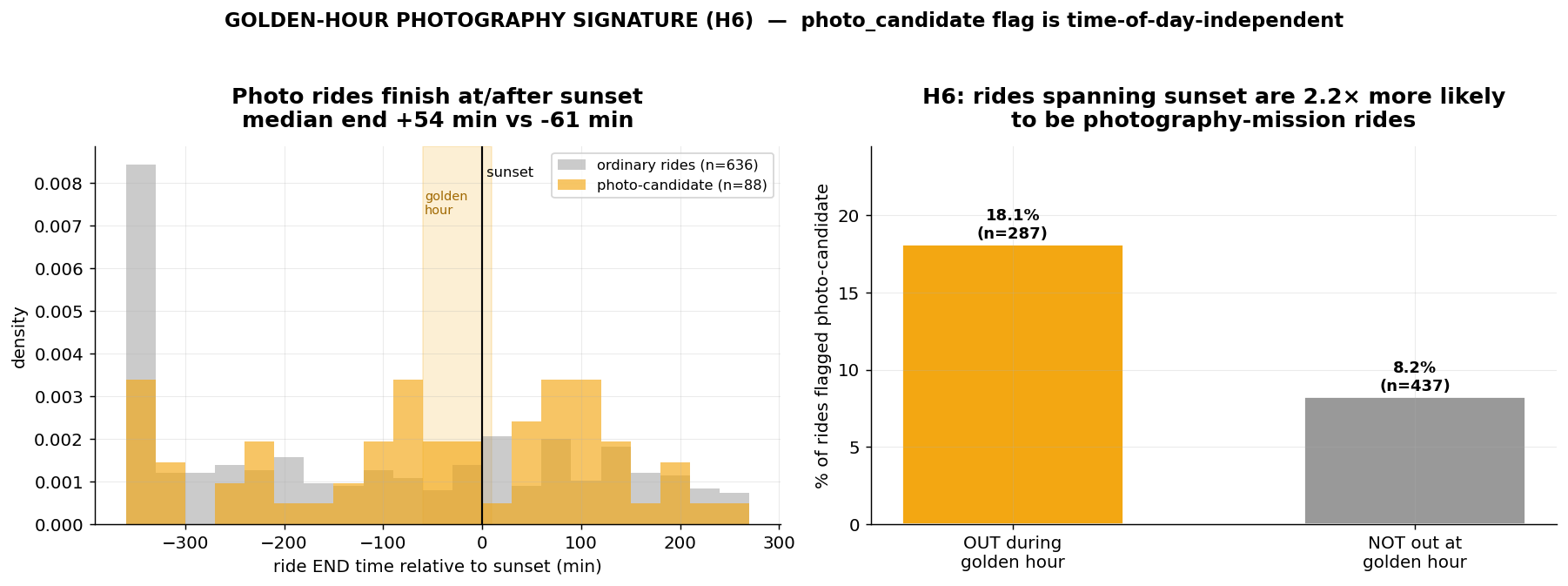
This is not speculation; it is a measurable, verified behavioral signature. Rides spanning the hour around sunset are 2.25× more likely to be slow, stop-heavy photography missions (p = 0.0004), and they finish a median of 54 minutes after sunset — he was out there for the light.
And he was migrating off Strava entirely. In the direct messages, six times between August and October 2024 — while riding at peak volume (40, 40, 46 rides those months) — he points people to Instagram:
"Honestly I'm mostly off Strava now. I just use it to see how many miles I'm keeping up but feel free to hit me up on ig" — Aug 30, 2024 (handle: @mark__lubin) "For now just mark__Lubin on ig." — Oct 24, 2024 (his literal last message in the export)
He was also, in his own framing, changing careers:
"Voluntary career break / mid-life crisis sort of deal… increasingly I am looking at figuring out how I can center my future around cycling." — Aug 27, 2024
This is the single most important correction to the naïve reading of this data. The "social death" on Strava in late 2024 is not withdrawal from life — it is a platform switch. Which means the collapse came in distinct, separable waves:
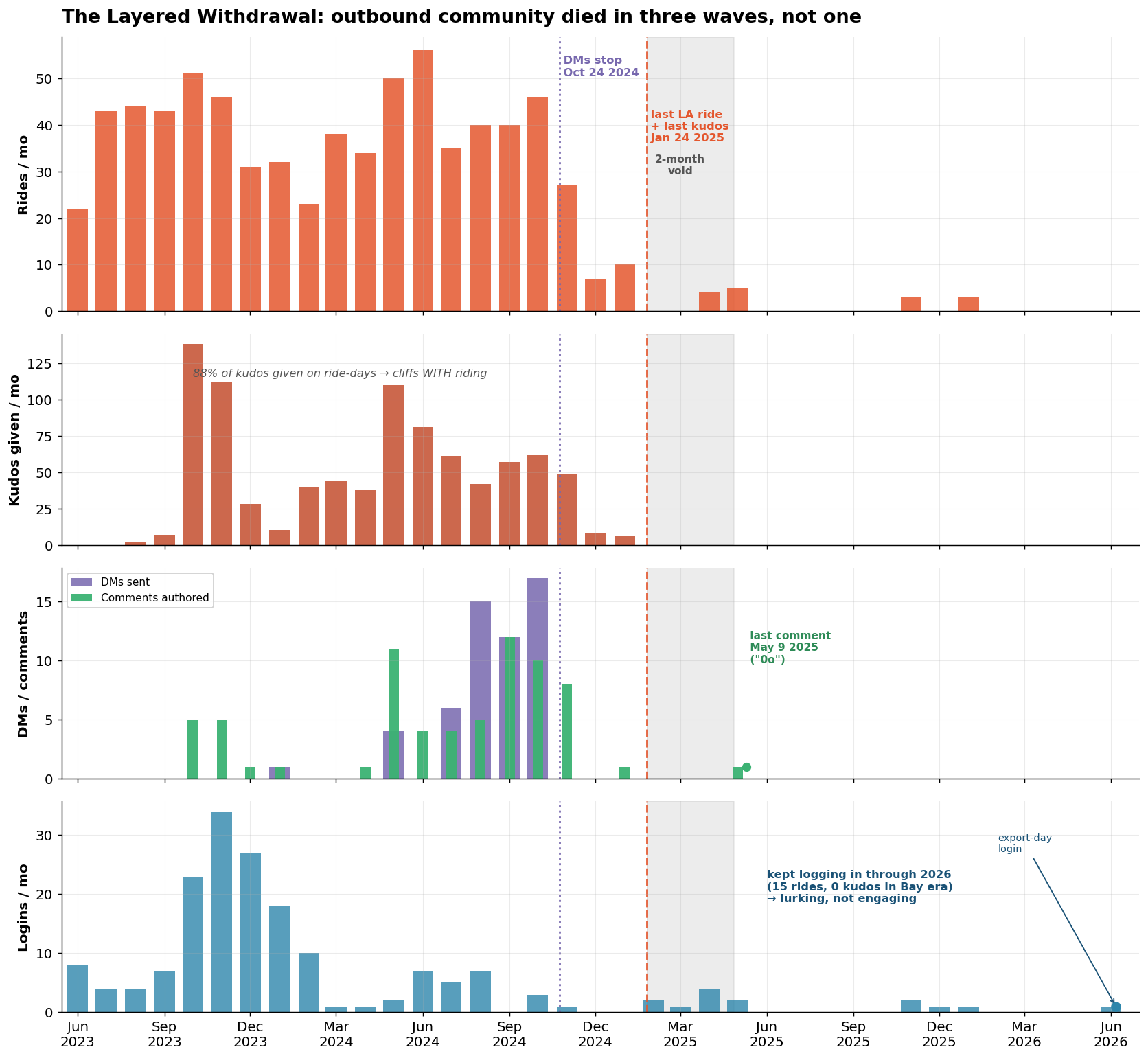
- Wave 1 — the deliberate outreach (Oct 2024). Last club joined Oct 19, last DM sent Oct 24. Private, intentional engagement goes to zero — a clean month before the riding even softened.
- Wave 2 — the documentation voice (Nov 2024). The custom names and written descriptions collapse. On Dec 8, 2024, on a ride where he forgot to stop his Garmin for 62 hours, he writes the thesis statement of the entire collapse:
"My tracking has been terrible lately. I'm still riding. I just don't really care that much about Strava. Presently it's not as relevant to the kind of writing I'm doing… spending hours screwing around with camera gear… I'm sure I will return in a more traditional form before long."
- Wave 3 — the riding itself (Dec 2024). The first missed week in 79 ends Dec 15, 2024 — a 4-sigma event after which the daily habit simply never restarts.
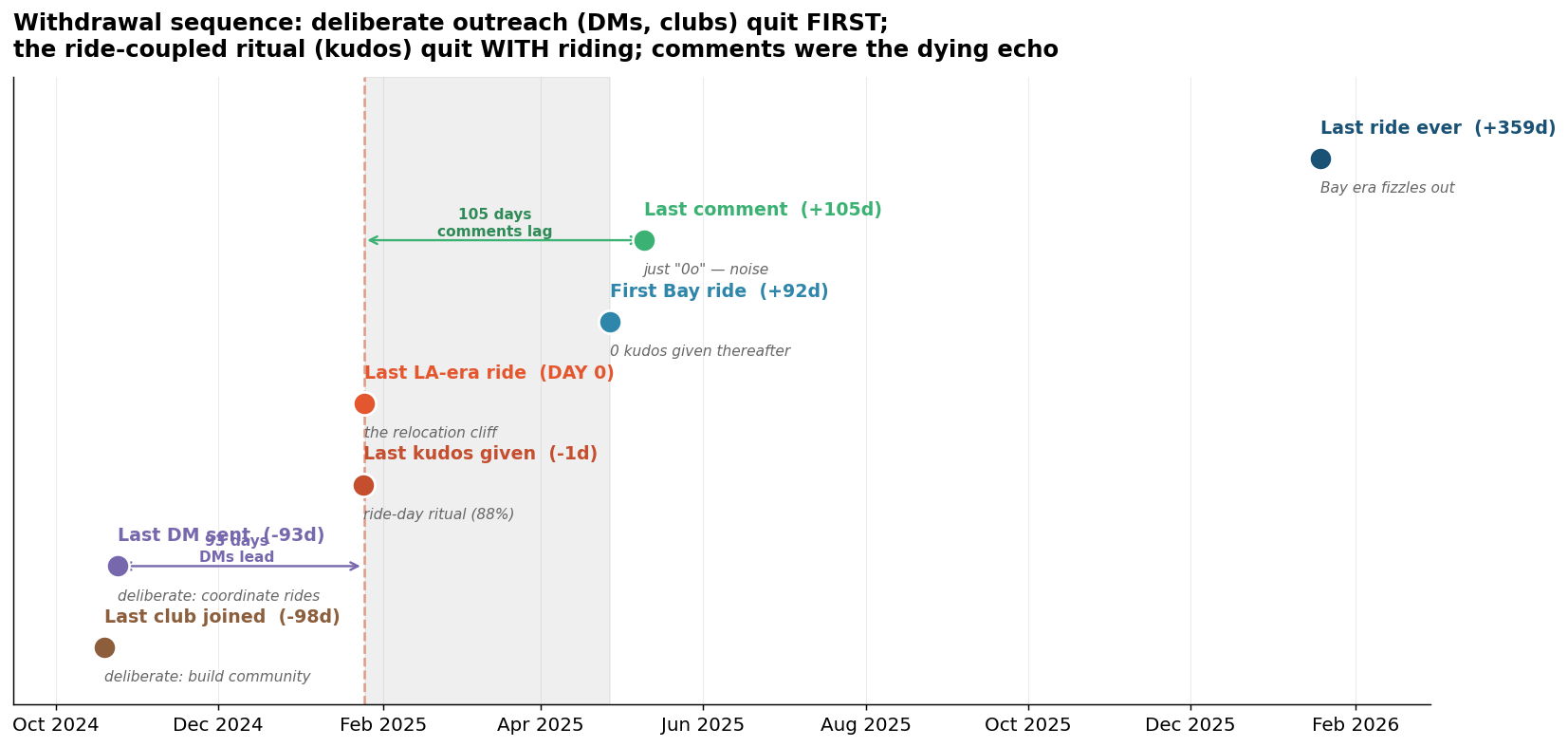
The one apparent exception proves the rule: kudos-giving cliffed on the exact same day as the riding (last kudos 2 hours before the last LA ride) — but only because 88% of his kudos were a ride-day reflex. When the riding stopped, the kudos stopped mechanically. They were a symptom, not a separate signal.
Act IV — The farewell and the void (January–April 2025)
The riding doesn't end on a quiet Tuesday. It ends with a trip.
From Jan 13–27, 2025, a final flare: seven rides around Santa Barbara, the first of them named "Triumphant return to Strava." It's a brief, deliberate documentation revival — half the rides custom-named, including "Searching for the truth behind solvang." The last LA-era ride is January 24, 2025, and its description outlines the new life directly:
…a "cycling photography gear startup which will entail a modular Milwaukee packout-style system for carrying photography equipment on a bicycle."
Then: silence. A 90-day void. No rides at all from January 27 to April 27, 2025. Somewhere in that gap, he moved to the Bay Area — the login IP shifts from the old LA address to a Bay-Area Comcast connection.
Act V — The Bay ghost (April 2025 – January 2026)
This is where every single modality flatlines together, and the convergence is the most damning finding in the analysis.
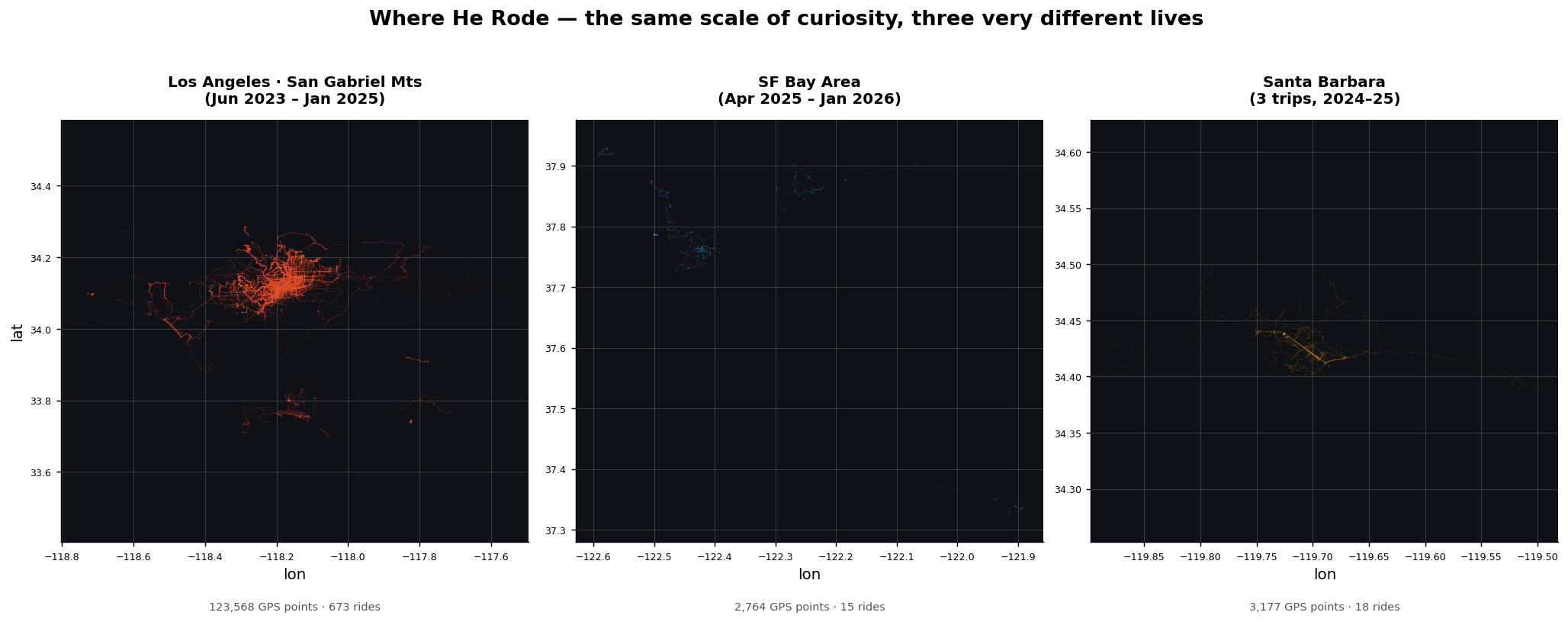
Look at the middle panel. After a metro that he'd traced into a dense web of 123,000 GPS points across 673 rides, the Bay is 15 rides, 2,764 points, disconnected fragments. And it is not just smaller — it is structurally unmoored:
- Geography: no home base (15 rides from 14 different start points; top cell just 13%). Zero mega-climbs — his biggest Bay climb (2,735 ft) wouldn't crack his LA top 70. A 193-day internal void (May 13 – Nov 22, 2025) sits inside this era — a collapse within the collapse.
- Society: 0 kudos given, 0 clubs joined, 0 real comments across 15 rides and 14 months. (The lone "comment" is "0o" — pocket noise.) All 25 of his clubs were LA; not one was ever rebuilt.
- Voice: 0 custom names, 0 descriptions, 0 videos. Every ride is a Strava default — "Evening Ride," "Lunch Ride." The man who wrote paragraphs about South Pasadena now says nothing at all.
And yet — the camera outlasted the racing. One of those silent, unnamed Bay "Evening Rides" (Nov 22, 2025) produced this:
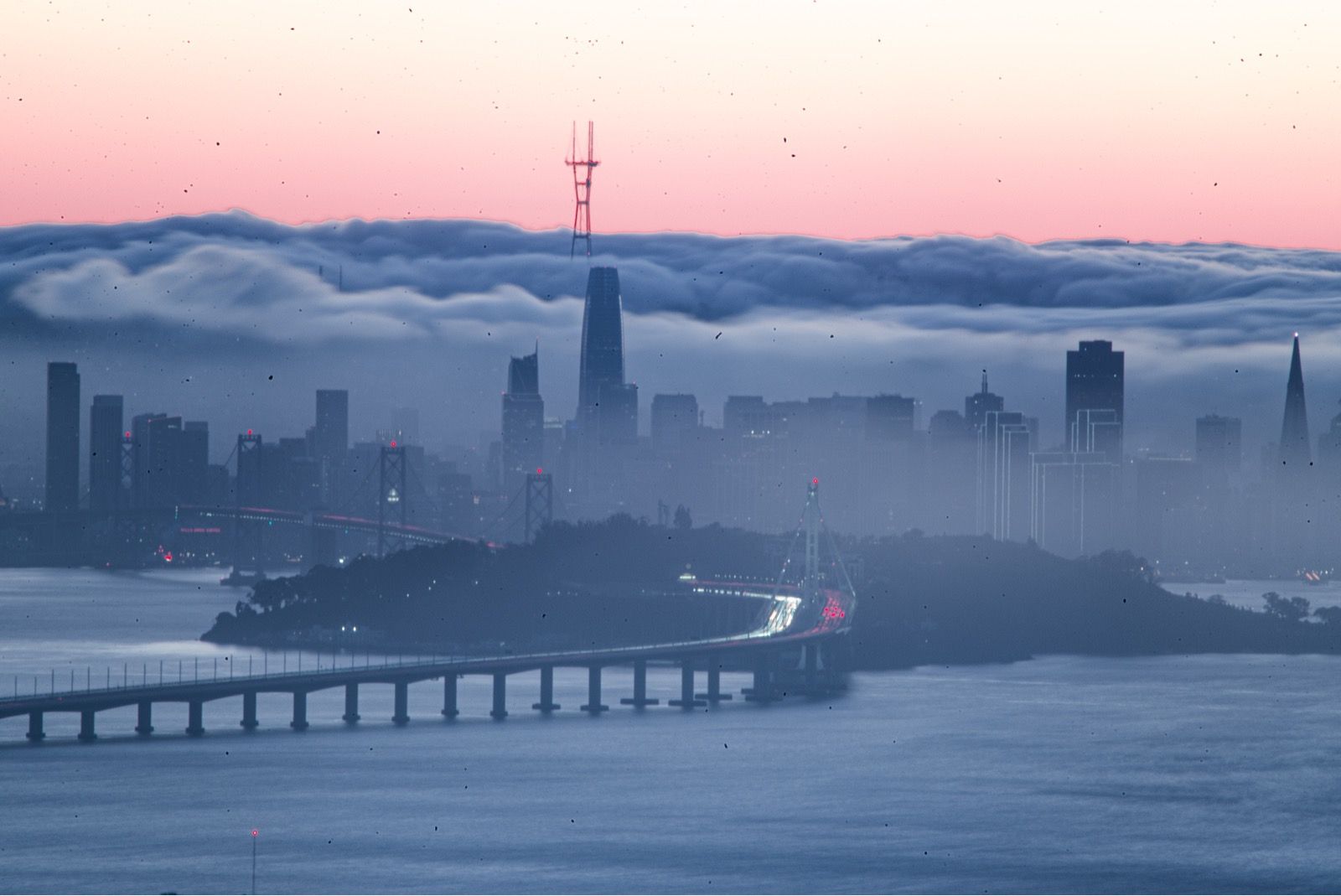
A deliberate, professional-grade telephoto of the San Francisco skyline at dusk — Sutro Tower, the Salesforce Tower, both spans of the Bay Bridge, fog, a pink sky — shot from the Berkeley hills. The cyclist had gone quiet. The photographer had not. In the Bay, the ride had become merely the vehicle to a view. (This is the genuine photography thread — not the "62-hour" rides, which are just forgot-to-stop-recording artifacts he named honestly, e.g. "Forgot to turn off garmin this is like a few seperate days in one…")
He never fully left, either. Logins continue through the export date of June 6, 2026 — including one the morning after his last-ever ride. Sixteen-plus months of a ghost checking a feed of the community he'd left behind.
What the data cannot say
This story is robust at the level of sequence and identity. It is genuinely under-determined at the level of single cause, and intellectual honesty requires saying so plainly:
- The invisible Instagram corpus is the load-bearing gap. He explicitly moved his cycling-photography identity to @mark__lubin. Everything we call "collapse" after October 2024 could be partial displacement to a platform we cannot see. We have proven that his Strava engagement died — not that his cycling-social life died.
- Four causes are stacked on one window. Across Dec 2024–Mar 2025, a behavioral collapse, the natural winter trough, the physical relocation, and the Instagram migration all happen at once. With only one prior December in the data (Dec 2023 = 31 rides), seasonality cannot be statistically separated from the collapse.
- The Bay era is N = 15. Every Bay statistic — no home base, harsher weather, gravel resurfacing — rests on a tiny sample and is directional, not precise.
- No HR, no training load, no RPE. The fatigue/injury/overtraining hypothesis for the collapse is completely untestable with this export.
- The 90-day and 193-day voids are unexplained. The data can timestamp them but cannot say whether they were logistics, motivation, injury, or life.
Curiosities — the gallery of surprising small things
- The fastest-looking bike is provably the slowest. "Slow Poke" holds the record raw top speeds in the dataset (up to 258 mph) — all phone-GPS glitches (one ride is named "I didn't have my Garmin so I use my phone and my phone sucks"). Clean the glitches and it's the slowest bike he owns.
- The 62-hour ride. His longest "moving time" is a forgot-to-stop artifact; the most extreme is 601 hours of elapsed time for 116 minutes of actual riding. He knew: "Forgot to turn off Garmin in the Uber so cropping it."
- The Bay isn't flatter — it's just missing the mountain. Climb-per-mile is statistically identical (64 vs 72 ft/mi). What vanished was the big day, not steeper roads.
- Gravel came back on the wrong bike. The dedicated gravel bike (Canyon Grizl) never made the move — but gravel riding resurfaced in Marin (China Camp, 89% dirt, Nov 2025) on the Slow Poke. The activity survived even though the gear was orphaned.
- A 12-day mountain-bike experiment that ended in a sentence. All 10 of his MTB rides fall in a single Sept 2023 window, after which a description reads: "Left me questioning if I actually like Mtb or just want to get in the drop and crank out some speed." He never logged the mountain bike again.
- He missed Pasadena before he left it. "I just really miss summer in Pasadena" — written Nov 13, 2024, while still living and riding there.
- The goal cut that wasn't an omen. In Jan 2024 he halved his weekly distance goal (200 → 100 mi) — and then rode more (~+10%) and had his best year. A healthy recalibration, not a warning sign.
Claims ledger
Every headline claim, with its post-verification status. confirmed = independently re-derived; corrected = direction holds, magnitude adjusted; refuted/rejected = did not survive.
| Claim | Confidence | Status |
|---|---|---|
| 79 consecutive weeks without a missed week; ~9 rides/wk; 0.74-day median gap; 45-day streak | high | confirmed |
| Riding collapse = mild Nov fade → Dec cliff (first 0-ride week w/e Dec 15 2024, z=−3.99) | high | confirmed (split corrected to ~41%/59%) |
| Deliberate outreach (DMs, clubs) died ~2–3 months before the riding cliff (last Oct 19/24 2024) | high | confirmed |
| The late-2024 Strava "social death" is contaminated by a documented Instagram migration | high | confirmed (his own words) |
| Solo / weekday / after-dark signature (~46% night, Friday #1, ~3% mornings) | high | confirmed |
| 25 clubs joined vs 3 Sunday-morning rides ever (aspirational scaffolding) | high | confirmed |
| All 44 mega-climbs (>3,281 ft) are LA-era; the San Gabriels were the soul (H5) | high | confirmed (peripheral numbers corrected) |
| LA anchored to one front door (~82% of rides) vs Bay unmoored (top cell 13%) | high | confirmed (contrast magnitude reduced) |
| "Slow Poke" = 25-lb paved utility daily-driver, NOT an e-bike; sole survivor of the move | high | confirmed (e-bike rejection re-grounded) |
Real power existed on only 32 rides (99 days); avg_watts is an unvalidatable estimate (H7) |
high | confirmed & sharpened |
| Golden-hour photography signature: sunset-spanning rides 2.25× more likely photo-missions (H6) | high | confirmed (test stats corrected) |
| He's a fair-weather rider (72% clear starts) who raced rain windows | high | confirmed |
| Bay era = near-total documentation + social blackout (0 names/descriptions/videos/kudos/clubs) | high | confirmed |
| He kept lurking 16+ months after the last meaningful act (logins to June 2026) | high | confirmed |
| The Jan-2024 goal downgrade was a leading omen of decline (H13) | high | refuted |
| A distinct "serious training persona" on the metered road bike (H8) | medium | partially rejected |
| Weather tolerance narrowed after the move (H9) | low | rejected (heavily confounded, N=9) |
| The 2024 "fitness decline" is pure measurement/bike artifact | medium | downgraded (~80% artifact; a real ~−0.28 mph/mo residual survives) |
| "Lost the specific LA community he was beginning to lead" (H10) | high | strongly confirmed |
| Travel produced joy-spikes (H12) | medium | mixed (true in naming, refuted in photo counts) |
Method (in brief)
Full provenance in METHOD.md. In short: a reproducible Python pipeline parsed activities.csv (quote-aware, duplicate-header-safe, unit-corrected) and decoded all 732 GPS tracks (520 FIT + 212 GPX → 134,559 trackpoints), joining them on the upload-id filename stem (not Activity ID — a subtle but critical fix, since FIT files are named by upload). Eras were locked from the observed monthly centroid timeline. Seven modal agents analyzed the canonical table; seven red-team agents adversarially re-verified; one synthesizer reconciled. A separate vision pass examined a sample of the actual ride photographs. The caveats above are not boilerplate — they are the verifiers' own flags.
This is one reading of a rich, ambiguous record — strong on what happened and in what order, honest about what it cannot prove about why. The next iteration's highest-value target is the data this export cannot see: the Instagram account where, the evidence suggests, the story actually continued.
Part Two → The Map He Drew — the same 13,000 miles read geographically: every neighborhood ridden through, the map filling in and then running out, the favorite roads, and the high points he kept climbing to.